-
TRACES 3 par COLLECTIF Jacques DUBOIS, Situation de Simenon Jacques DE DECKER, Le paradis du paradigme Claude DIRICK, Georges Simenon et André Gide Waclaw RAPAK, Une lecture existentielle d’Une Confidence de Maigret de Georges Simenon René ANDRIANNE, Trois écrivains aux U.S.A. : Camus, Sartre, Simenon Bernard ALAVOINE, De Camus à Simenon : le héros et l’étrangeté Michel LEMOINE, Évolution et parentés littéraires de Simenon selon la critique de 1931 à 1935 Jean FABRE, Simenon, Céline et Borges Alain BERTRAND, Georges Simenon et le genre policier Pierre DELIGNY, La place de Simenon dans les dictionnaires et les encyclopédies Paul MERCIER, Simenon sociologue ? Simenon, sociologue raté ou les deux bouts de la vie
-
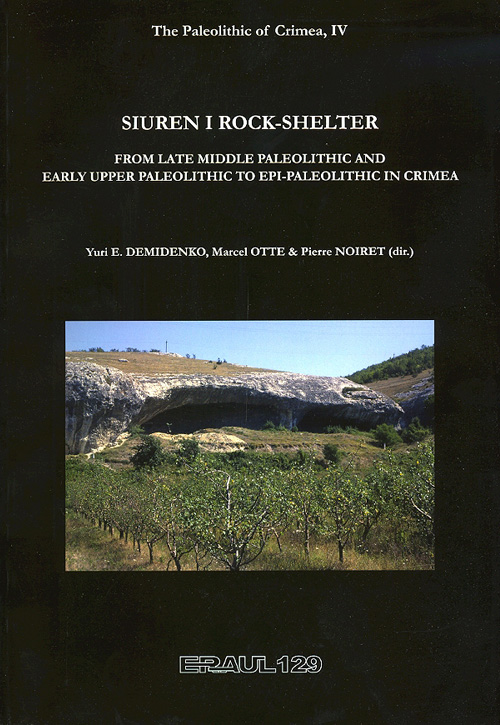
From Late Middle Paleolithic and Early Upper Paleolithic to Epi-Paleolithic in Crimea. [The Paleolithic of Crimea, IV] par Yuri E. DEMIDENKO, Marcel OTTE & Pierre NOIRET (dirs) Table of content Préface | Foreword | Marcel Otte The history of investigations at Siuren I and different interpretations of the site’s archaeological context | Yuri E. Demidenko Siuren I: excavation strategies and methodologies | Alexandre I. Yevtushenko† Siuren I: Stratigraphic and Archaeological Sequences for the 1990s Excavations | Alexandre I. Yevtushenko† Radiocarbon Dates for the Siuren I sequence | Yuri E. Demidenko & Pierre Noiret Zooarchaeological analysis of the faunal assemblages from Siuren I, Crimea (Ukraine) | Jessica Massé & Marylène Patou-Mathis Small Mammals from Paleolithic Site Siuren I | Anastasia K. Markova Snail Fauna Data from Siuren I | Constantine Mikhailesku The Worked Bone Artifacts from the Siuren I Rock-Shelter (Crimea): the 1990s Excavation | Natalia B. Akhmetgaleeva The Classification and Attribute Analysis System Applied to the Siuren I Lithic Assemblages | Yuri E. Demidenko Unit H: Lithic Artifacts | Yuri E. Demidenko & Victor P. Chabai Unit G: Lithic Artifacts | Yuri E. Demidenko & Victor P. Chabai Unit F: Lithic Artifacts | Yuri E. Demidenko & Victor P. Chabai Unit E-A: Lithic Artifacts | Yuri E. Demidenko Inter-Unit and Inter-Level Comparisons of Assemblages from the 1990s Units H, G and F | Yuri E. Demidenko Comparisons between the Siuren I Assemblages from the 1920s Lower and Middle Layers and the 1990s Units G and F | Yuri E. Demidenko Interpretation of the Middle Paleolithic Component in the Early Aurignacian Units H and G and the 1920s Lower Layer | Yuri E. Demidenko The Problem of Industrial Attribution of Artifacts from the Upper Cultural Bearing Deposits at Siuren I: 1920s Excavations Upper Layer and 1990s Excavations Units E-A | Yuri E. Demidenko The Siuren-I Aurignacian of Krems-Dufour Type Industries in the Context of the European Aurignacian | Yuri E. Demidenko & Pierre Noiret Small Laminar Blanks at Siuren I Rockshelter: Technological & Comparative Approach | Nicolas Zwyns The Siuren I Archaeological Industrial Sequence seen Through the Site’s Human Occupation Events | Yuri E. Demidenko Looking East | Marcel Otte Concluding Considerations | Yuri E. Demidenko Perspectives | Marcel Otte & Pierre Noiret References
-
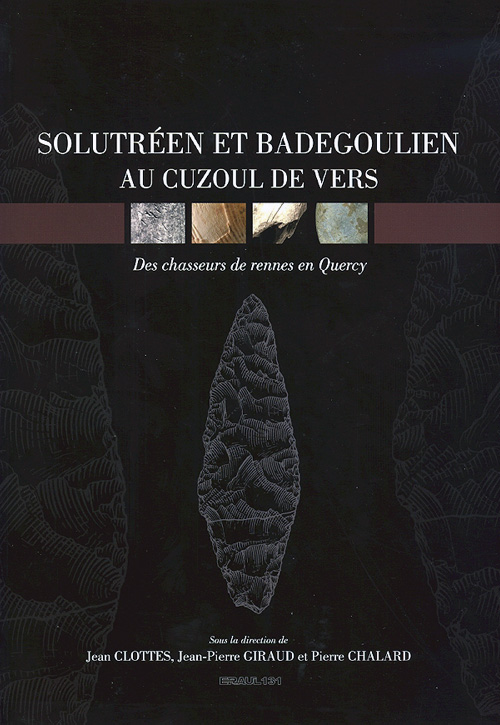
Stock épuiséDes chasseurs de rennes en Quercy par Jean CLOTTES, Jean-Pierre GIRAUD & Pierre CHALARD (dir.) Table des matières
Préface | Jacques Jaubert, Michel Barbaza & Michel Vaginay Avant-propos | Jean Clottes, Jean-Pierre Giraud & Pierre Chalard Historique des recherches : la découverte, la fouille et l’étude | Jean Clottes & Jean-Pierre Giraud Le cadre naturel | Guy Astruc & Laurent Bruxelles Lithostratigraphie, dynamique sédimentaire et implications | Bertrand Kervazo & Stéphane Konik Les micromammifères | Emmanuel Desclaux Le cadre chronologique : datations 14C | Christine Oberlin & Hélène Valladas Les industries lithiques du Solutréen Pierre Chalard, André Morala & Alain Turq, Pétroarchéologie du silex Christian Servelle, Les autres roches Caroline Renard, L’organisation des productions en silex, implications techno-économiques Les industries lithiques du Badegoulien Pierre Chalard, André Morala & Alain Turq, Pétroarchéologie du silex Christian Servelle, Les autres roches Jean Clottes, Carole Fritz, Jean-Pierre Giraud & Christian Servelle, Les galets portant des traces d’utilisation Sylvain Ducasse & Laure-Amélie Lelouvier, Techno-économie des équipements en silex, une première approche diachronique L’art mobilier : le galet gravé badegoulien | Jean Clottes, Carole Fritz, Jean-Pierre Giraud, Christian Servelle Les colorants | Marie-Pierre Pomiès & Colette Vignaud Archéozoologie | Jean-Christophe Castel Analyse cémentochronologique | Hélène Martin & Olivier Le Gall, avec la collaboration de Bernard Martin Premier regard sur la matière dure animale ouvragée | Yanik Le Guillou Les coquillages | Yvette Taborin Le travail du bois de renne dans les couches badegouliennes | Jean-Marc Pétillon & Aline Averbouh Les vestiges humains : deux exemples de traitement du cadavre | Dominique Henri-Gambier & Sébastien Villotte Structures d’habitat et organisation de l’espace | Nathalie Fourment & Jean-Pierre Giraud De 20 000 à 18 000 BP en Quercy : Apports de la séquence du Cuzoul de Vers à la compréhension de l’évolution des comportements socio-économiques entre Solutréen et Badegoulien | Sylvain Ducasse & Caroline Renard
avec la collaboration de Guy Astruc, Aline Averbouh, Laurent Bruxelles, Jean-Christophe Castel, Pierre Chalard, Jean Clottes, Emmanuel Desclaux, Nathalie Fourment, Carole Fritz, Jean-Pierre Giraud, Dominique Henri-Gambier, Bertrand Kervazo, Stéphane Konik, Olivier Le Gall, Yanik Le Guillou, Laure-Amélie Lelouvier, Bertrand Martin, Hélène Martin, André Morala, Christine Oberlin, Jean-Marc Pétillon, Marie-Pierre Pomiès, Christian Servelle, Yvette Taborin, Alain Turq, Hélène Valladas, Colette Vignaud, Sébastien Villotte
Bibliographie -
par Audrey MOUTAT
Cet ouvrage s’inscrit dans la continuité des réflexions de l’auteure sur la sémiotique de la perception et la communication du sensible. S’appuyant sur les propositions formulées en phénoménologie, en design sonore et en sémiotique, cette étude se structure en trois axes qui tracent le parcours du sens sonore, de la perception des sons à leur conceptualisation, en passant par leur mise en discours. Les sons étudiés se distinguent des objets musicaux. Il s’agit des sons du quotidien isolés en écoute réduite ou intégrés au sein de paysages sonores naturels ou construits par une activité de design. Objets sensibles parmi les plus invasifs, les sons s’avèrent pourtant les moins familiers pour la culture occidentale. Ils soulèvent de nombreux problèmes communicationnels, essentiellement liés à la pauvreté du lexique ordinaire et à un manque de connaissance du sonore. Communiquer sur les sons, ce n’est pas se référer à ce qui les origine ni aux effets qu’ils produisent sur le sujet mais les décrire pour ce qu’ils sont. Ancré dans la tradition structuraliste, ce travail montre ainsi comment les phénomènes sonores se configurent en structures signifiantes dotées de propriétés à partir desquelles il est possible de proposer de nouvelles pistes de conceptualisation et de catégorisation des phénomènes sonores.
Audrey MOUTAT est maître de conférences en sémiotique et en sciences de l’information et de la communication à l’université de Limoges. Elle mène ses travaux de recherche sur la sémiotique de la perception à laquelle elle a consacré de nombreux articles ainsi que son ouvrage Du sensible à l’intelligible. Pour une sémiotique de la perception (Éditions Lambert-Lucas, 2015). Sa recherche s’étend également aux dispositifs de médiation et de médiatisation du sensible investis dans différents objets tels que les textes, la photographie, les objets de design, le son ou encore le numérique.
-
Préhistoire de la musique, Actes du colloque international de Musicologie (Liège, 11-13 décembre 1993) par Marcel OTTE (éd) Résumé indisponible.
-
Avec Jean-Pierre Bertrand édité par Laurent DEMOULIN, Justine HUPPE, François PROVENZANO et Denis SAINT-AMAND « Je voudrais également terminer en disant qu’il y a certes pour moi dans cette question de l’influence de l’intérêt intellectuel, littéraire, philosophique, vous l’aurez deviné. Mais il y a peut-être aussi de l’intéressement psychologique, affectif, social aussi (comprenne qui pourra) : c’est que l’influence — et la littérature nous l’enseigne au mieux — touche à notre identité, à ce dont nous sommes faits, à ce qui nous constitue au cours d’une existence, à savoir ce mixte et cette pluralité de voix qui parlent en nous, d’images qui nous façonnent, de conduites qui nous construisent, de modèles qui nous habitent. Occasion pour moi de saluer quelques-uns parmi vous ici présents qui ont immanquablement joué ces rôles d’influenceurs, qu’ils soient parents, amis, professeurs, collègues. » C’est par ces mots que, le 7 mars 2019, Jean-Pierre Bertrand terminait sa leçon inaugurale à la Chaire Francqui décernée par l’université de Namur, et consacrée à « L’influence en littérature », le grand chantier de recherche qu’il ouvrait alors. Son décès inopiné, en mars 2022, a laissé ce projet inachevé et nous a plongés dans un état de tristesse et de sidération. Ce volume voudrait rendre hommage à Jean-Pierre Bertrand et poursuivre ses réflexions, en reprenant avec lui les idées et les manières de faire auxquelles il nous a fait tenir. Les contributions ici rassemblées proviennent de collègues et d’ami·es qui l’ont connu, et ont voulu cultiver son influence. Sous forme d’influx, en s’inspirant de ses hypothèses de travail pour les mettre à l’épreuve de nouveaux terrains. Sous forme de reprises, en essayant de prolonger des pistes qu’il a ouvertes. Sous forme d’échos, en renouant les liens humains, toujours vivants, qui rendent son travail si personnel, et si attachant.
-
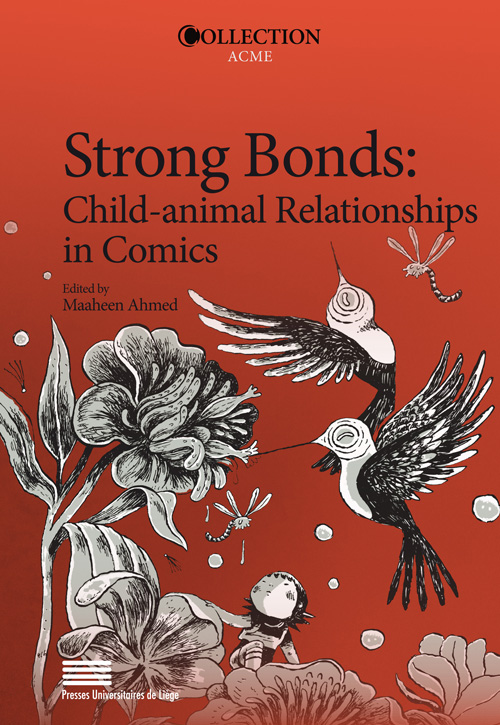
par Maaheen Ahmed (ed.)Snoopy and Charlie Brown, Calvin and Hobbes, Tintin and Snowy… comics are home to many memorable child and animal figures. Many cultural productions, especially children’s literature and cartoons, stress the similarities between children and animals, similarities that have their limits and often place the child, as human, above the animal. Still, these fictional situations offer opportunities for thinking of child-animal relationships in diverse ways through, for instance, considering the possibilities of privileged contact between children and animals or of animals that are more knowledgeable and powerful than children and even adults. Despite the prevalence and success of child-animal tandems in comics and culture, we know very little about these relationships. What makes them so popular? How do they work? How much do they vary across time and cultures? What do they tell us about the place of animals and children in comics and in the real world? Strong Bonds: Child-animal Relationships in Comics takes a first, important step in this direction. Bringing together scholars with a diverse range of comics expertise, the volume’s chapters combine contextualized readings of comics with relevant theories for interrogating childhood and animalhood, their overlaps and divergences. The strong bonds between children and animals mapped out here point towards alternative modes of conceptualizing family and identity and, ultimately, alternative means of reading, interpreting and imagining. With chapters on early comics (the Italian children’s magazine Corriere dei Piccoli during WWI, Harold Gray’s Little Orphan Annie) international and regional classics (Tintin, the Flemish Jommeke) and contemporary graphic novels (Bryan Talbot’s A Tale of One Bad Rat, Brecht Even’s Panther), this critical anthology sheds light on a vast array of child-animal relationships in comics from Europe and North America. Maaheen Ahmed is an associate professor of comparative literature at Ghent University. She is author of Openness of Comics (2016) and Monstrous Imaginaries: The Legacy of Romanticism in Comics (2020). She is currently principal investigator of the ERC-funded project COMICS which seeks to piece together an intercultural history of children and comics.
-
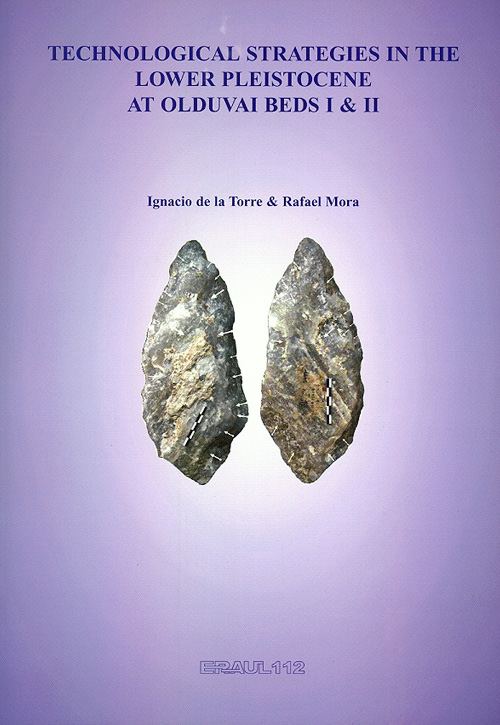
par Ignacio DE LA TORRE & Rafael MORA Abstract
This book envisages an analysis of the lithic collections from several sites Mary Leakey excavated between 1960 and 1963 in Bed I and II at Olduvai (Tanzania), currently stored at the National Museum of Nairobi (Kenya) and previously published in a classic monograph (Leakey 1971). Nonetheless, we have conceived this study from a standpoint that relates more to aspects concerning technical production than to the typological issues that governed Leakey’s approximation. Furthermore, the Olduvai collections will be contemplated from a contextual prism, bearing in mind a constant concern in reconstructing the processes that formed the archaeological record, aiming to understand the differences or similarities that appear between the different assemblages. This monograph focuses on the analysis of lithic materials. We assume blood cannot be squeezed from stones, paraphrasing the title of one of the articles by Isaac (1977b). Yet, we can reconstruct part of the puzzle concerning human evolution by understanding the technological guidelines and technical patterns in use during the transformation processes, which are, in short, telling of the hominids´ behaviour. A meticulous analysis of the lithic objects can provide valuable information to comprehend their technical abilities, cognitive skills and economic concerns. Therefore, each lithic object will be studied analytically, attempting to integrate them in the corresponding stage of the chaîne opératoire. It is essential to keep a distance from the last works that examined the Olduvai sequence (Ludwig 1999; Kimura 1997, 1999, 2002). Therein, artefact categories stand their own ground (in a classically typological conception), and are compared in isolation throughout a chronological sequence. In contrast, we consider that it is essential to analyse each lithic element in connection with others, and each site as a whole, since each assemblage is subjected to specific, exceptional circumstances. Only upon understanding each collection after comparing the different categories it comprises, it is possible to elaborate conclusions that can subsequently be extrapolated and compared to the facts documented in other sites. This work contains constant references to the terms Oldowan and Acheulean. The Oldowan was defined precisely in Olduvai, therefore this location is the perfect setting for the justification of the term. In fact, the term Oldowan has well-defined chronological and cultural connotations, whilst Mode 1 defined by Grahame Clark (1969) has, over recent years, been used without enough precision. The same occurs with the Acheulean, which will predominate herein over the term Mode 2, and which also presents specific technological, chronological and cultural features. One of the key goals this work establishes is precisely to define the attributes that characterise the Oldowan and the Acheulean, and to attempt to understand the technological and cultural connotations this differentiation entails. Therefore it is essential that this dichotomy exists explicitly in our discourse. In the first chapter we will expound some general notions on the historiography of the Olduvai expeditions, the stratigraphy, the radiometric and paleo-ecological framework, the archaeological sequence Leakey defined, and the methodology employed in our re-examination. By doing so, we aim to create a suitable contextual framework in which to develop the technological study. As regards all other matters, the index of this work respects a diachronic structure, starting with the oldest sites in Bed I and moving through the archaeological sequence to the top of Bed II, the chronological limit for our research. After presenting a systematic description of each site in its corresponding chapter, general conclusions that summarise and present a global interpretation of the Olduvai sequence appear at the end of the monograph. Our goal is to combine a systematic study of the lithic reduction methods and chaînes opératoires, with a vaster vision that integrates these technical systems in the general framework of the land-use by hominids. We assume that the manufacturing of any stone tool is the result of a series of technical, economic, social and symbolic options that can be encompassed under the term strategies (Perlès 1992:225). From this general perspective, in this work we will attempt to understand the technological strategies used by the humans that lived in Olduvai during the Lower Pleistocene. (The authors).
-
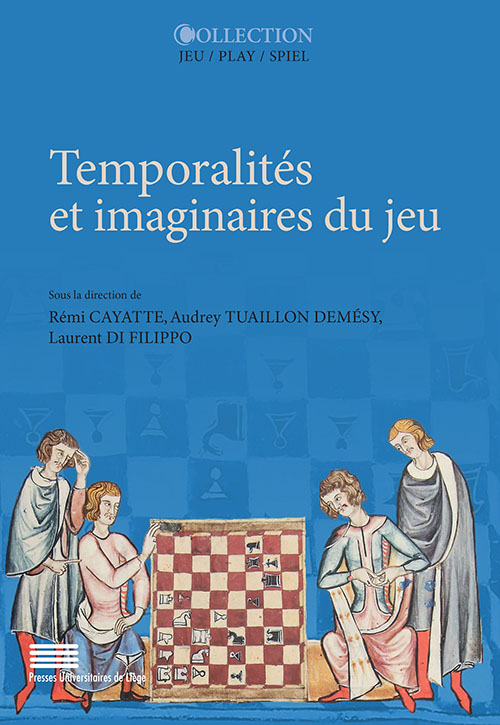
Rémi Cayatte, Audrey Tuaillon Demésy et Laurent Di Filippo (dirs)
Cet ouvrage pluridisciplinaire réunit les contributions de douze chercheurs et chercheuses s’inscrivant dans le champ des études universitaires sur les jeux. Il est centré sur les manières dont différents imaginaires contribuent à la construction de mondes du jeu (vidéo, de rôle, sportif, etc.) et aborde comment les mécanismes temporels participent à la structuration et à l’appropriation d’expériences ludiques. Les douze chapitres de cet ouvrage sont organisés autour de deux axes principaux. Dans une optique principalement narrative, le premier s’intéresse aux contenus des jeux, aux temporalités intradiégétiques ainsi qu’aux spécificités relatives à leurs mises en scène. Quant au second, il se situe dans une perspective davantage ancrée en sciences sociales et s’intéresse aux pratiques ludiques et aux dimensions temporelles qu’elles permettent d’expérimenter. Entièrement dédié aux questions temporelles et à la manière dont elles sont véhiculées par et dans des imaginaires ludiques, ce volume place au coeur de son propos des réflexions qui demeurent encore à la marge des recherches en sciences du jeu.
Rémi CAYATTE est docteur en Sciences de l’information et de la communication, maître de conférences en SIC à l’université Toulouse III. Ses recherches portent sur les notions de communication, d’agentivité et d’expressivité dans les systèmes de jeu et plus largement dans les dispositifs d’interaction.
Laurent DI FILIPPO est docteur en Sciences de l’information et de la communication et en études scandinaves et maître de conférences en SIC à l’université de Lorraine. Ses recherches portent sur la réutilisation des mythes nordiques et de l’imaginaire viking dans les médias contemporains, ainsi que sur les rapports entre jeux et faits religieux.
Audrey TUAILLON DEMÉSY est docteure en sociologie, professeure en STAPS à l’université de Franche-Comté (laboratoire C3S). Ses travaux portent sur les cultures alternatives (sports subculturels, reconstitutions historiques, culture punk) et les imaginaires, notamment du temps, qui les entourent.
-
Selected papers from the meeting of the Computer Working Group of the International Association of Egyptologists (Informatique & Égyptologie), Liège, 6-8 July 2010 par Stéphane POLIS et Jean WINAND with the collaboration of Todd GILLEN Présentation du volume
This volume represents the outcome of the meeting of the Computer Working Group of the International Association of Egyptologists (Informatique & Égyptologie) held in Liège in 2010 (6-8 July) under the auspices of the Ramses Project. The papers are based on presentations given during this meeting and have been selected in order to cover three main thematic areas of research at the intersection of Egyptology and Information Technology: (1) the construction, management and use of Ancient Egyptian annotated corpora; (2) the problems linked to hieroglyphic encoding; (3) the development of databases in the fields of art history, philology and prosopography. The contributions offer an up-to-date state of the art, discuss the most promising avenues for future research, developments and implementation, and suggest solutions to longstanding issues in the field.
Two general trends characterize the projects laid out here: the desire for online accessibility made available to the widest possible audience; and the search for standardization and interoperability. The efforts in these directions are admittedly of paramount importance for the future of Egyptological research in general. Indeed, for the present and increasingly for the future, one cannot overemphasize the (empirical and methodological) impact of a generalized access to structured data of the highest possible quality that can be browsed and exchanged without loss of information.
Notice des auteurs
Stéphane POLIS is Research Associate at the National Fund for Scientific Research (Belgium). His fields of research are Ancient Egyptian linguistics and Late Egyptian philology and grammar. His work focuses on language variation and language change in Ancient Egyptian, with a special interest for the functional domain of modality. He supervises the development of the Ramses Project at the University of Liège with Jean Winand.
Jean WINAND is professor ordinarius at the University of Liège, and currently Dean of the Faculty of Philosophy and Letters. He specializes in texts and languages of ancient Egypt. His major publications include Études de néo-égyptien. La morphologie verbale (1992); Grammaire raisonnée de l’Égyptien classique (1999, with Michel Malaise); Temps et Aspect en égyptien. Une approche sémantique (2006). He launched the Ramses Project in 2006, which he supervises with Stéphane Polis.
-
par Anta MONTET-WHITE (éd) Résumé indisponible.
-
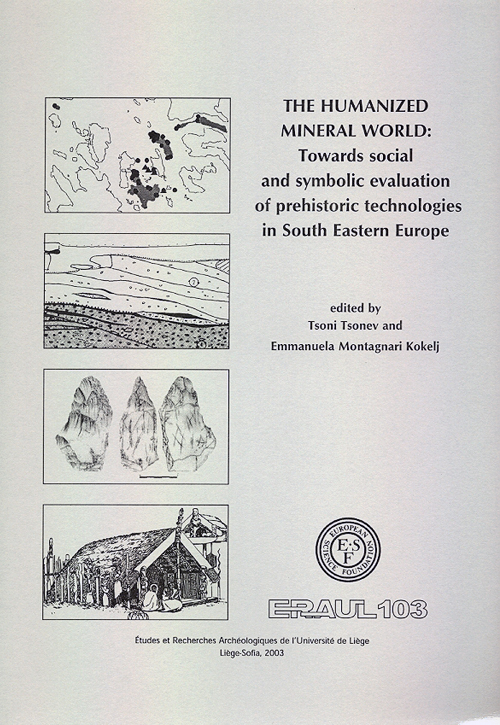
Proceedings of the ESF workshop, Sofia 3-6 september 2003 par Tsoni TSONEV and Emmanuela MONTAGNARI KOKELJ Résumé indisponible.
-
Proceedings of the First International Seminar on Ancient Greek Cult, organised by the Swedish Institute at Athens and the European Cultural Centre of Delphi (Delphi, 16-18 November 1990) Robin HÄGG (ed.) B. ALROTH, Changing modes of representation of cult images F. VAN STRATEN, The iconography of epiphany in Classical Greece (summary) P.G. THEMELIS, The cult scene on the polos of the Siphnian caryatid at Delphi I. LOUCAS, Meaning and place of the cult scene of the Ferrara krater T128 A. VERBANCK-PIERARD, Herakles at feast in Attic art : a mythical or cultic iconography ? E. LOUCAS-DURIE, Some comments on the scene on the Cabiric vase Athens, N.M. 424 Ch. SCHEFFER, Boiotian festival scenes : competition, consumption, and cult in Archaic black figure G. NORDQUIST, Instrumental music in Greek cult representations R. HÄGG, A scene of funerary cult from Argos U. SINN, The ‘Sacred Herd’ of Artemis at Lousoi U. HUBINGER, The cult in the ‘Sanctuary of Pan’ on the slopes of Mount Lykaion Index
-
par Talia SHAY & Jean CLOTTES (éds) Résumé indisponible.
-
par Jean-Marie LE TENSORER, Reto JAGHER & Marcel OTTE (eds.) Table of content The Core-and-Flake Industry of Bizat Ruhama, Israel: Assessing Early Pleistocene Cultural Affinities | Yossi Zaidner New Acheulian Locality North of Gesher Benot Ya´aqov – Contribution to the Study of the Levantine Acheulian | Gonen Sharon The Lower Palaeolithic in Syria | Sultan Muhesen & Reto Jagher Innovative human behavior between Acheulian and Mousterian: A view from Qesem Cave, Israel | Ran Barkai & Avi Gopher The Mugharan Tradition Reconsidered | Avraham Ronen, Izak Gisis & Ivan Tchernov Recent progress in Lower and Middle Palaeolithic research at Dederiyeh cave, northwest Syria | Yoshihiro Nishiaki, Yosef Kanjo, Sultan Muhesen & Takeru Akazawa Le Yabroudien en Syrie : état de la question et enjeux de la recherche | Amjad Al Qadi The contribution of Hayonim cave assemblages to the understanding of the so-called Early Levantine Mousterian | Liliane Meignen Capturing a Moment: Identifying Short-lived Activity Locations in Amud Cave, Israel | Erella Hovers, Ariel Malinsky-Buller, Mae Goder-Goldberger & Ravid Ektshtain Late Levantine Mousterian Spatial Patterns at Landscape and Intrasite Scales in Southern Jordan | Donald O. Henry Levallois points production from eastern Yemen and some comparisons with assemblages from East-Africa, Europe and the Levant | Rémy Crassard & Céline Thiébaut Development of a geospatial database with WebGIS functions for the Paleolithic of the Iranian Plateau | Saman Heydari, Elham Ghasidian, Michael Märker & Nicholas J. Conard The Late Middle Palaeolithic and Early Upper Palaeolithic of the northeastern and eastern edges of the Great Mediterranean (south of Eastern Europe and Levant): any archaeological similarities ? | Yuri E. Demidenko The Archaeology of an Illusion: The Middle-Upper Paleolithic Transition in the Levant | John J. Shea La transition du Moustérien à L’Aurignacien au Zagros | Marcel Otte & Janusz Kozlowski El Kowm, a key area for the Palaeolithic of the Levant in Central Syria | Reto Jagher & Jean-Marie Le Tensorer Nadaouiyeh Aïn Askar – Acheulean variability in the Central Syrian Desert | Reto Jagher The faunal remains from Nadaouiyeh Aïn Askar (Syria). Preliminary indications of animal acquisition in an Acheulean site | Nicole Reynaud Savioz Hummal: a very long Paleolithic sequence in the steppe of central Syria – considerations on Lower Paleolithic and the beginning of Middle Paleolithic | Jean-Marie Le Tensorer, Vera von Falkenstein, Hélène Le Tensorer & Sultan Muhesen Chronometric age estimates for the site of Hummal (El Kowm, Syria) | Daniel Richter, Thomas C. Hauck, Dorota Wojtczak, Jean-Marie Le Tensorer & Sultan Muhesen A Yabroudian Equid skull and upper cheek teeth from the site of Hummal (El Kowm, Syria) | Hani El Suede The Lower Palaeolithic assemblage of Hummal | Fabio Wegmüller A three-dimensional model of the Palaeolithic site of Hummal (Central Syria) | Daniel Schuhmann Hummal (Central Syria) and its Eponymous Industry | Dorota Wojtczak The Mousterian sequence of Hummal and its tentative placement in the Levantine Middle Palaeolithic | Thomas C. Hauck
-
Stefano G. CANEVA
Studies in the cultic honours for Hellenistic leaders and benefactors mainly focus on the ideological and diplomatic features of the phenomenon. Conversely, the papers collected in this volume aim to shift the focus to its material and practical aspects: media, ritual action and space, agency, administration and funding. Specialists in Hellenistic history, epigraphy, papyrology, numismatics, and archaeology provide fresh reassessments of a variety of documentary dossiers concerning both institutional and non-institutional agents (cities, kingdoms; individuals, associations), Greek and non-Greek, across the Hellenistic Eastern Mediterranean world. Moreover, this interdisciplinary investigation of the materiality of rituals addressed to human benefactors as to, or together with, traditional gods allows us to go beyond a commonly accepted yet methodologically arbitrary separation between cultic honours for deities and for human beings. The latter are often still considered as an isolated and paradoxical feature of ancient Greek polytheism, and as a deviation from ‘traditional’ religion, i.e., the cults for gods and heroes as they were already practised in the archaic and classical polis. Rather, the case studies dealt with in this book contribute to shedding new light on the way ancient people could exploit the ritual and administrative toolkit of their religious system in order to satisfy new needs. In other words, one may state that cultic honours for political leaders do not provide an exception to the way Greek polytheism functioned, but are fully embedded within it, and substantially contributed to its development in the Hellenistic age.
Table des matières (PDF) -
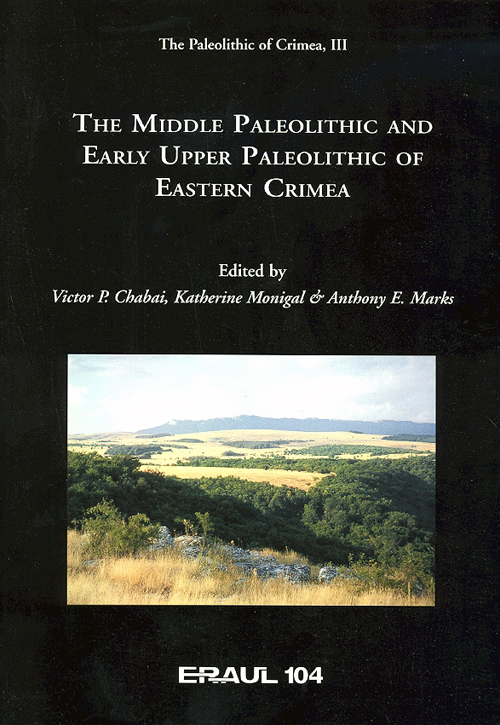
par Victor P. CHABAI, Katherine MONIGAL & Anthony E. MARKS (eds) Résumé indisponible.
-
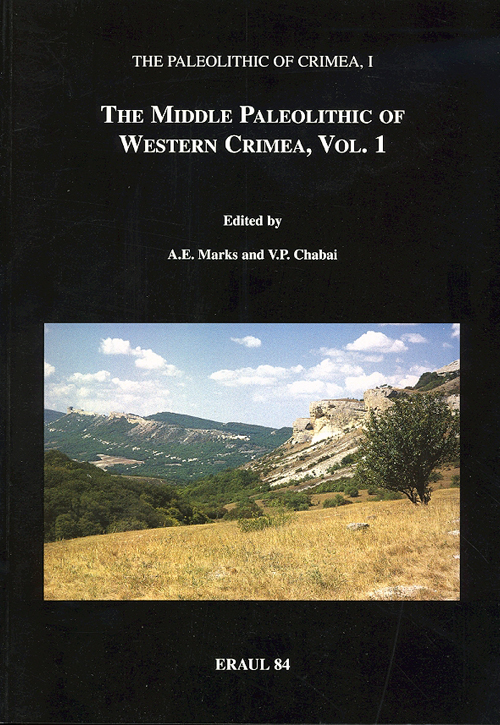
par Anthony E. MARKS & Victor P. CHABAI (éd.) Résumé indisponible.
-
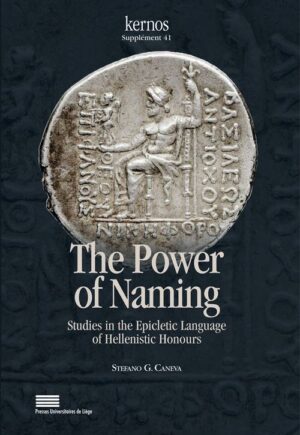
Studies in the Epicletic Language of Hellenistic Honours Stefano G. CANEVA
This book focuses on the contribution of epithets and compound denominations to the definition of the religious figure of sovereigns and other political leaders in the Hellenistic world, from Philip II and Alexander III to Kleopatra VII and the beginning of the Roman Principate.
Questions and methodologies related to the political history of the Hellenistic Mediterranean are combined with the results of recent studies in the functioning of the Greek epicletic system to provide a fresh reassessment of the entanglement between honorific practices and the religious life of Hellenistic communities, from continental Greece to Egypt, from Syracuse to Bactria. Reconsidering the relationships between honours and religion also implies reversing the question of the influence of Greek religion on Hellenistic ruler cults to explore how a new tradition of ritual encounters between human power and the divine sphere may have impacted post-classical developments in Greek polytheism.
Table des matières (PDF) -
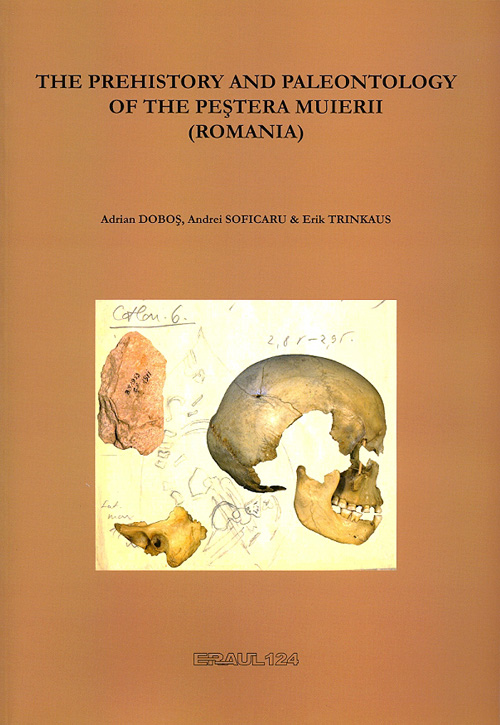
par Adrian DOBOS, Andrei SOFICARU & Erik TRINKAUS Table of Content Chapter 1 | Introduction Chapter 2 | The Peştera Muierii: geological context and chronology Chapter 3 | A history of investigations at the Peştera Muierii Chapter 4 | The vertabrate paleontological remains Chapter 5 | The Paleolithic assemblages Chapter 6 | The Holocene archeological remains Chapter 7 | The Pleistocene human remains Chapter 8 | The Holocene human skeleton from the Galeria Principală Chapter 9 | Paleonthropological implications of the Peştera Muierii Chapter 10 | References