-
Sociologie de la « révolution » tunisienne. L’exception tunisienne : vers un « compromis historique » ? Portefeuille de lecture & Thèmes des exposés par NACHI, Mohamed BLOC 1 du grade de Master en Anthropologie, Sciences de la Population et du Développement BLOC 2 du grade de Master en Sociologie
-
Portefeuille de lectures par PONCELET, Marc BLOC 2 du grade de Bachelier en Sociologie et Anthropologie, Information et Communication Master en Histoire de l’Art et Archéologie
-
par ROOSEN, Marie BLOC 1 du grade de Bachelier en Architecture
-
Portefeuille de lecture par PONCELET, Marc BLOC 1 du grade de Master en Sociologie et Anthropologie, Sciences de la Population et du Développement
-
Énoncés des exercices par HENRY, Valérie BLOC 1 du grade de Bachelier en Sciences économiques et de Gestion
-
par HENRY, Valérie BLOC 1 du grade de Bachelier en Sciences économiques et de Gestion
-
Théorie par HAESBROECK, Gentiane BLOC 1 du grade de Bachelier en Ingénieur de Gestion
-
Exercices par HAESBROECK, Gentiane BLOC 1 du grade de Bachelier en Ingénieur de Gestion
-
Portefeuille de lectures par PONCELET, Marc BLOC 1 du grade de Master en Anthropologie, Sociologie, Langues et Lettres françaises et romanes BLOC 2 du grade de Master en Sciences de la Population et du Développement, Sociologie
-
par LEJEUNE, Brigitte BLOC 2 du grade de Master en Logopédie
-
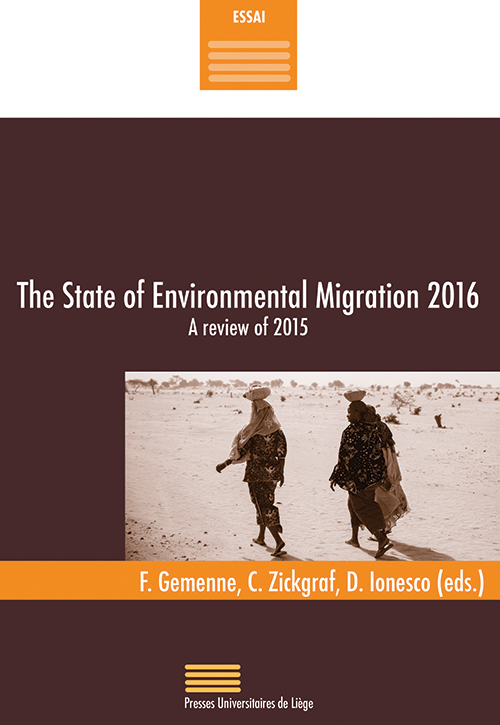
Stock épuiséA review of 2015 par François GEMENNE, Caroline ZICKGRAF, Dina IONESCO (eds.)
A propos de l’ouvrage
The State of Environmental Migration 2016: Review of the Year 2015 is the sixth annual volume of the series, which selects and compiles Masters students’ work from the course “Environment and Migration” at the Paris School of International Affairs (PSIA) of Sciences Po in an ongoing partnership with the International Organization for Migration (IOM). Each year, students detail and analyze the year’s environmental events insofar as they have affected various forms of migration. This volume includes several important illustrations: landslides in Colombia, floods in India, an earthquake in Pakistan.
Overall, 2015 has been a key year with regard to policy developments relating to environmental migration issues. First, the Nansen Initiative, an intergovernmental process launched in 2012 by the governments of Norway and Switzerland, concluded in October with the adoption by 109 States of a Protection Agenda that outlines the rights of those displaced across borders by disasters. Secondly, the adoption of the Paris Agreement at the COP21 in December of 2015 was the key policy event of the year. The first universal agreement on climate change is mostly focused on greenhouse gas emissions reductions, but also addresses migration and displacement, as it created a task force to advise the UNFCCC bodies on these issues. The task force is expected to serve as a hub for the integration of research and policy on climate change and migration in the UNFCCC negotiations, and should be established as part of the Warsaw International Mechanism on Loss & Damage. This new edition of The State of Environmental Migration will hopefully serve as a reminder of the magnitude and importance of the challenges to come.
François GEMENNE is Director of the Hugo Observatory at the University of Liege, where he is senior research associate with the Belgian Fund for Scientific Research (FRS-FNRS).
Caroline ZICKGRAF is Deputy Director of the Hugo Observatory as well as Post-doctoral Fellow with the Belgian Fund for Scientific Research (FRS-FNRS).
Dina IONESCO is the Head of the Migration, Environment and Climate Change (MECC) Division at the International Organization for Migration (IOM).
-
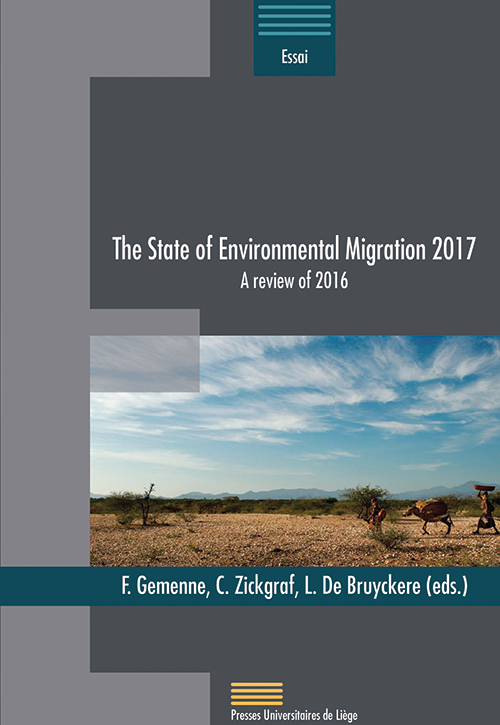
Stock épuiséA review of 2016 par François GEMENNE, Caroline ZICKGRAF, Luka De BRUYCKERE (eds.)
This volume is the seventh in the annual series and the second of its kind published with the Presses Universitaires de Liège. The State of Environmental Migration aims to provide its readership with the most updated assessments on recent events and evolving dynamics of environmental migration throughout the world. Each year, the editors select the best graduate student work from the course “Environment and Migration”, taught by François Gemenne and Caroline Zickgraf, at the Paris School of International Affairs (PSIA) of Sciences Po. Presented in this edition are displacements induced by some of the most dramatic disaster events of 2016, including Hurricane Matthew, as well as analyses of migration flows related to a variety of environmental occurrences throughout the year spanning the globe. SEM 2017 thus represents another stepping stone towards understanding the broad spectrum that is environmental migration.
François GEMENNE is Director of the Hugo Observatory at the University of Liège, where he is senior research associate with the Belgian Fund for Scientific Research (F.R.S.-FNRS).
Caroline ZICKGRAF is Deputy Director of the Hugo Observatory as well as Post-doctoral Fellow with the Belgian Fund for Scientific Research (F.R.S.-FNRS).
Luka DE BRUYCKERE is Research Assistant at the Hugo Observatory.
-
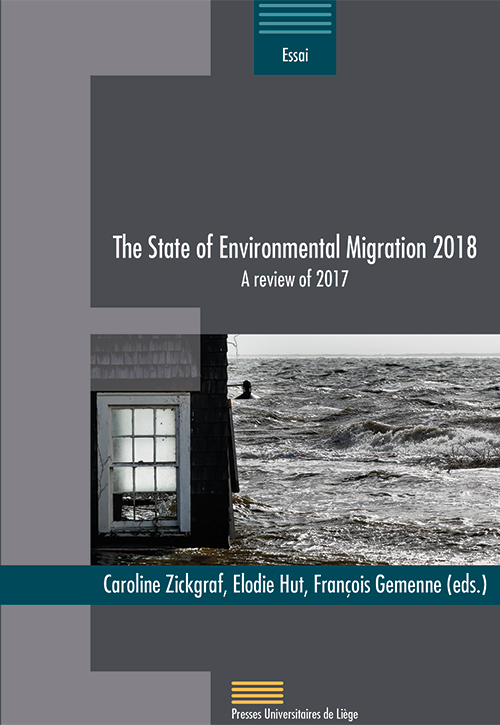
A review of 2017 par Caroline ZICKGRAF, Elodie HUT, François GEMENNE (eds.)
This volume is the eight in the annual series and the third of its kind published with the Presses Universitaires de Liège. The State of Environmental Migration aims to provide its readership with the most updated assessments on recent events and evolving dynamics of environmental migration throughout the world. Each year, the editors select the best graduate student work from the course “Environment and Migration”, taught by François Gemenne and Caroline Zickgraf at the Paris School of International Affairs (PSIA) of Sciences Po. Presented in this edition are displacements induced by some of the most dramatic disaster events of 2017, including Hurricane Irma and Cyclone Enawo, as well as analyses of migration flows related to a variety of environmental occurrences throughout the year spanning the globe. SEM 2018 thus represents another stepping stone towards understanding how the adverse effects of climate change and disasters alter migration patterns.
Caroline ZICKGRAF is the Deputy Director of the Hugo Observatory as well as Post-doctoral Fellow with the Belgian Fund for Scientific Research (F.R.S.-FNRS).
Elodie HUT is a Research Assistant at the Hugo Observatory.
François GEMENNE is the Director of the Hugo Observatory at the University of Liège, where he is a senior research associate with the Belgian Fund for Scientific Research (F.R.S.-FNRS).
-
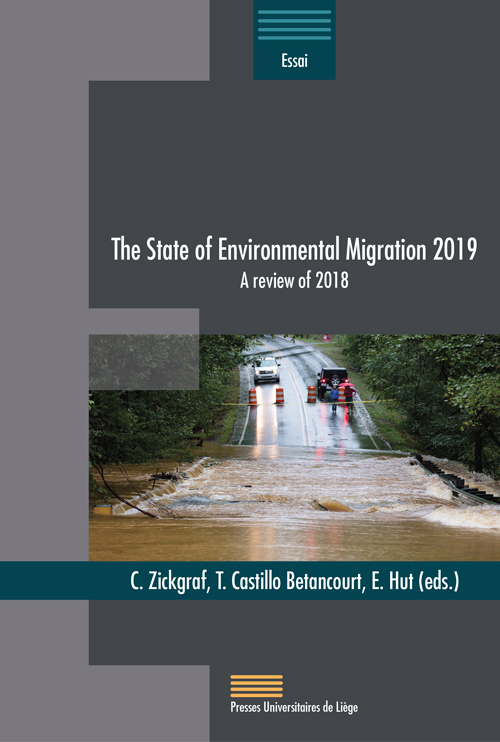
A review of 2018 par C. ZICKGRAF, T. CASTILLO BETANCOURT, E. HUT (eds.)Edited by The Hugo Observatory of the University of Liège, this volume is the ninth in the annual series and the fourth of its kind published with the Presses Universitaires de Liège. The State of Environmental Migration aims to provide its readership with the most updated assessments on recent events and evolving dynamics of environmental migration throughout the world. Each year, the editors select the best graduate student work from the course “Environment and Migration” taught by Caroline Zickgraf at the Paris School of International Affairs (PSIA) of Sciences Po. In this edition, the effects on migration and displacement of some of the most dramatic disasters of 2018 are studied, including the Sulawesi earthquake and tsunami in Indonesia, Hurricane Florence and Camp Fire (which was the deadliest and most destructive wildfire in California’s history) in the United States, and the Volcán de Fuego eruption in Guatemala. The relationship between progressive environmental changes and migration in the Nepalese Hindu Kush Himalayas, and the effects of armed conflicts on the prevention and management of disaster-induced displacement in Afghanistan are also analysed and discussed. Caroline Zickgraf is Deputy Director of the Hugo Observatory as well as Post-doctoral Fellow with the Belgian Fund for Scientific Research (F.R.S.-FNRS). Tatiana Castillo Betancourt is Research Assistant at the Hugo Observatory. Elodie Hut is PhD candidate at the Hugo Observatory.
-
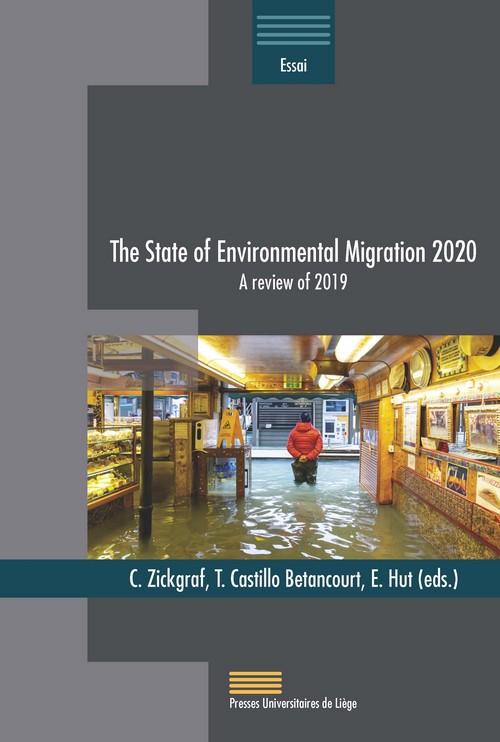
A review of 2019 par Caroline ZICKGRAF, Tatiana CASTILLO BETANCOURT et Elodie HUT (eds.)
Edited by The Hugo Observatory of the University of Liège, this volume is the tenth in the annual series and the fifth of its kind published with the Presses Universitaires de Liège. The State of Environmental Migration aims to provide its readership with the most updated assessments on recent events and evolving dynamics of environmental migration throughout the world. Each year, the editors select the best graduate student work from the course “Environment and Migration” taught by Caroline Zickgraf at the Paris School of International Affairs (PSIA) of Sciences Po. This year’s authors focus primarily on sudden-onset displacement events, including the Australian megafires, the dam failure in Brumadinho (Brazil), the floods in Budrio (Italy), the Kerala floods (India), and cyclones Idai and Fani in Mozambique and India. The relationship between drought and conflict-related internal displacement in Somalia’s Bay Region, as well as the importance of populations’ perceptions of environmental risk on (im)mobility outcomes during acqua alta in Venice are analysed and discussed.
Caroline Zickgraf is Deputy Director of the Hugo Observatory as well as Post-doctoral Fellow with the Belgian Fund for Scientific Research (F.R.S.-FNRS). Tatiana Castillo Betancourt is Project Manager at the Hugo Observatory. Elodie Hut is PhD candidate at the Hugo Observatory.
Edité par l’Observatoire Hugo de l’Université de Liège, ce volume est le dixième de la série annuelle et le cinquième du genre publié aux Presses Universitaires de Liège. Cet ouvrage vise à fournir à ses lecteurs les évaluations les plus à jour sur les événements récents et l’évolution de la dynamique des migrations environnementales à travers le monde. Chaque année, les éditeurs sélectionnent les meilleurs travaux d’étudiants diplômés du cours « Environnement et migrations », dispensé par Caroline Zickgraf à l’école des Affaires Internationales (PSIA) de Sciences Po (Paris). Les auteurs de cette année se concentrent principalement sur les événements de déplacement soudain, y compris les feux australiens, la rupture du barrage à Brumadinho (Brésil), les inondations à Budrio (Italie), les inondations au Kerala (Inde) et les cyclones Idai et Fani au Mozambique et en Inde. La relation entre la sécheresse et les déplacements internes liés au conflit dans la région de la baie de la Somalie, ainsi que l’importance des perceptions des populations du risque environnemental sur les résultats de l’(im)mobilité lors de l’acqua alta de Venise sont également analysées et discutées.
Caroline Zickgraf est directrice adjointe de l’Observatoire Hugo ainsi que post-doctorante au Fonds belge pour la recherche scientifique (F.R.S.-FNRS). Tatiana Castillo Betancourt est responsable de projet à l’Observatoire Hugo. Elodie Hut est doctorante à l’Observatoire Hugo.
-
Sensibilisation à la Forme et à l’Espace Notes de Cours. Théorie/Synthèse. par BRIBOSIA, Patrick BLOC 1 du grade de Bachelier en Architecture
-
Dossier de lectures par SERVAIS, Véronique BLOC 1 du grade de Bachelier en Sciences humaines et sociales, Sociologie et Anthropologie, Information et Communication, Philosophie Faculté de Philosophie et Lettres
-
Corpus de presse par GEUENS, Geoffrey BLOC 3 du grade de Bachelier en Sciences humaines et sociales, Information et Communication Bachelier en Langues et Lettres modernes, Histoire de l’Art et Archéologie, Histoire, Philosophie, Langues et Lettres françaises et romanes, Langues et Lettres anciennes BLOC d’aménagement aux Masterx en Information et Communication, Linguistique, Journalisme, Communication
-
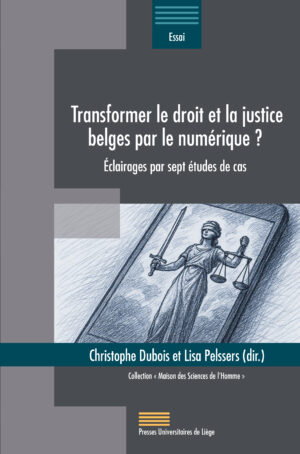
Éclairages par sept études de cas par Christophe DUBOIS et Lisa PELSSERS (dir.)
Depuis une vingtaine d’années, la Belgique mise sur les technologies numériques pour moderniser les administrations publiques et, plus particulièrement, les institutions judiciaires. Les solutions développées depuis lors contribuent-elles pour autant à transformer le droit et la justice ? En s’appuyant sur des études de cas, cet ouvrage rend compte des équipements numériques développés par ou pour des acteurs spécifiques, qu’il s’agisse des avocats, des notaires, des éditeurs juridiques, du Conseil d’État, des tribunaux de police, du travail ou de l’entreprise. La méthodologie adoptée combine interviews, observations et analyses documentaires afin d’examiner les processus de conception, de développement, de maintenance et d’adoption de ces équipements. Une attention particulière est réservée aux contextes locaux et aux dynamiques professionnelles qui façonnent ces dispositifs, tout en étant façonnés par eux. On voit alors apparaître les infrastructures sociotechniques des organisations judiciaires et des professions juridiques. Souvent invisibles, ces infrastructures sont paradoxales : essentielles au fonctionnement quotidien des organisations, elles génèrent de nouveaux problèmes techniques et menacent, parfois, l’indépendance de la justice. Ce livre initie ainsi une réflexion ancrée et nuancée sur ces questions, tout en interrogeant les promesses et les défis de la numérisation du droit et de la justice.
Christophe DUBOIS est professeur ordinaire à la Faculté des Sciences Sociales de l’ULiège et directeur du Centre de Recherches et d’Intervention Sociologiques au sein de l’Institut de Recherche des Sciences Sociales (CRIS/IRSS). Après avoir étudié les politiques et organisations carcérales, il s’intéresse depuis plusieurs années aux processus de numérisation du droit et de la justice. Lisa PELSSERS est assistante et doctorante en sciences politiques et sociales au Centre de Recherches et d’Interventions Sociologiques (CRIS/IRSS) à l’ULiège. Ses principaux axes de recherche portent sur la numérisation des cours et tribunaux et plus spécifiquement sur le rôle des instruments numériques dans la redéfinition des pratiques, des savoirs et des interactions entre les acteurs impliqués dans l’élaboration du droit.